
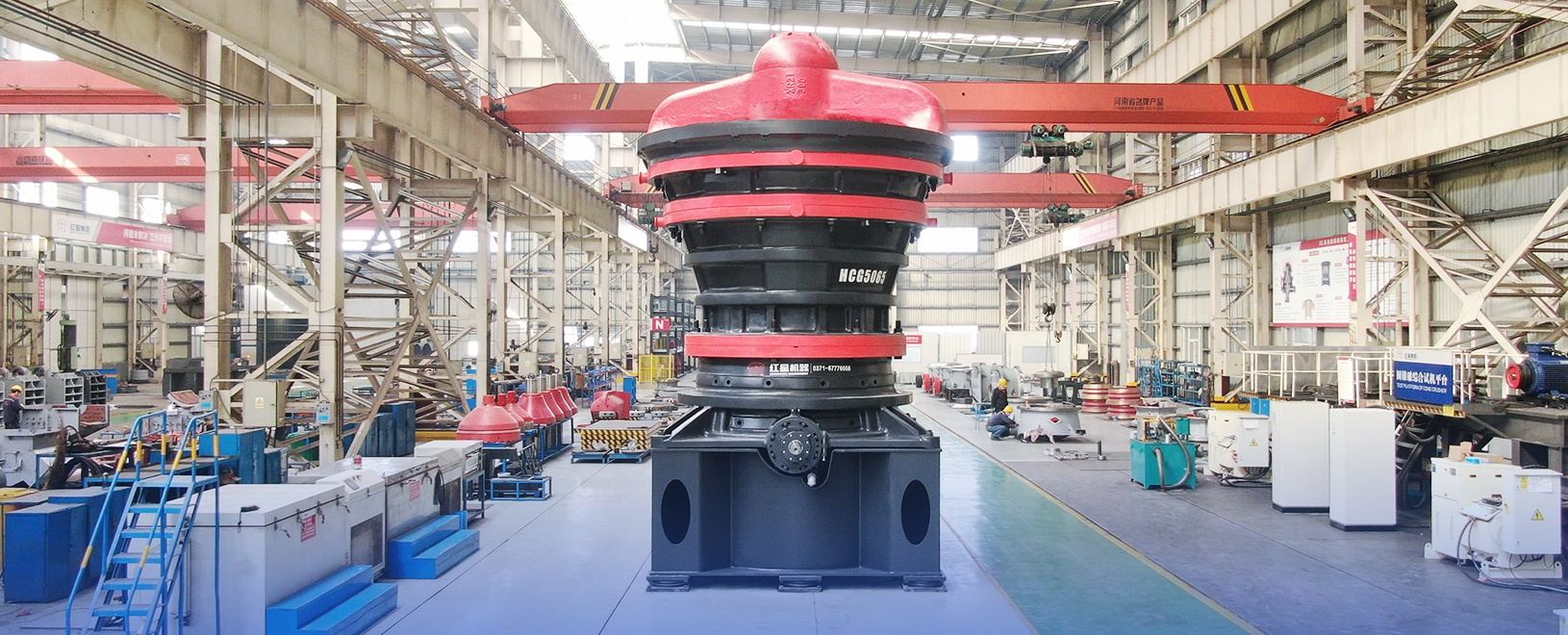
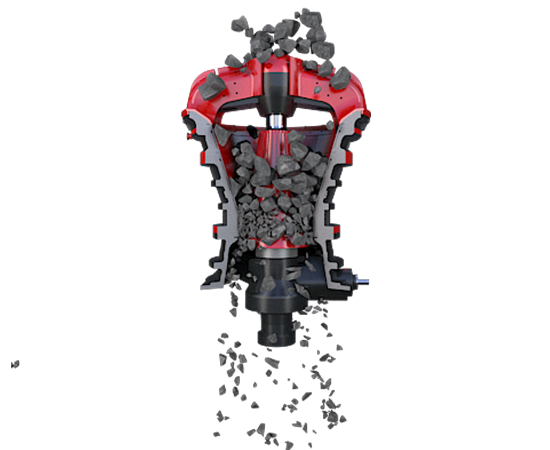
Based on the integration of advanced European and American technologies with the demands of modern industrial development, the gyratory crusher is a novel type of primary crushing equipment independently developed to address the specific global market demand for large-scale machinery. It operates by utilizing the gyratory motion of a crushing cone within the conical chamber of the machine housing to subject materials to compressive, splitting, and bending forces; it is characterized by high throughput and a large feed opening.
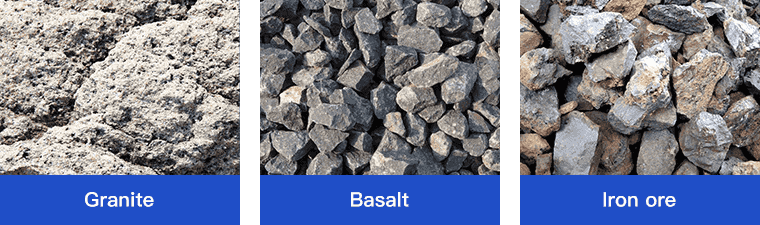
The gyratory crusher is suitable for crushing high-to-medium hardness materials, such as granite, basalt, and iron ore.
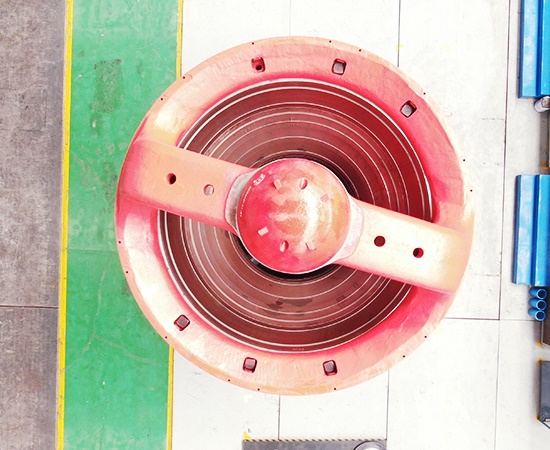
During operation, the motor drives a horizontal shaft to rotate; this shaft, via a gear mechanism, drives an eccentric sleeve to rotate. The eccentric sleeve, in turn, causes the movable cone to perform a circular gyratory motion, thereby achieving continuous compressive crushing of the rock material. The size of the discharge opening can be adjusted by manipulating a hydraulic cylinder located at the base of the movable cone, allowing for convenient control over the product's grain size. Furthermore, the hydraulic cylinder incorporates an "iron-passing" protection function: should an uncrushable object enter the crushing chamber, the cylinder automatically lowers the movable cone to release the object, thereby safeguarding the chamber from damage.
Equipped with a standard displacement sensor, the system provides a clear, real-time display of the spindle's position. An automatic hydraulic pressure compensation mechanism adjusts the discharge opening to offset liner wear, thereby ensuring consistent product granularity and boosting productivity.
Featuring a steeply angled crushing chamber and an extended crushing surface, the machine delivers superior crushing capacity. The spacious chamber design facilitates efficient inter-particle crushing through compression, thereby enhancing overall efficiency and extending the service life of the liners.
The spindle is constructed from a single-piece forging, effectively eliminating the risk of the moving cone becoming loose. The upper journal has been enlarged and features a polished, large-radius fillet design, ensuring exceptional structural strength.
Wear distribution across the entire crushing chamber is significantly more uniform. This reduces the frequency of liner replacements, thereby lowering overall production costs.
| Model | Feeding opening size (mm) |
Maximum Feeding size (mm) |
Adjustment range of discharge port (mm) |
Capacity (t/h) |
Power (kw) |
Dimensions L×W×H(mm) |
| HCG4265 | 1065 | 900 | 140-175 | 2018-2878 | 400 | 3940×4170×6900 |
| HCG5065 | 1270 | 1050 | 150-175 | 2403-2943 | 400 | 4460×4430×7610 |
| HCG5475 | 1370 | 1150 | 150-200 | 2893-3493 | 450 | 4930×4925×8410 |
| HCG6275 | 1575 | 1350 | 150-200 | 2898-4338 | 450 | 5580×5250×9090 |
| HCG6089 | 1525 | 1300 | 165-230 | 4203-5813 | 630 | 5590×5445×10470 |
| HCG60110 | 1525 | 1300 | 175-250 | 5543-8898 | 1250 | 6200×5940×11390 |
Note:processing Capacity May Vary With Different Materials And Feeding Sizes.
| Model | Feeding opening size (mm) |
Maximum Feeding size (mm) |
Capacity (t/h) |
| HCG4265 | 1065 | 900 | 2018-2878 |
| HCG5065 | 1270 | 1050 | 2403-2943 |
| HCG5475 | 1370 | 1150 | 2893-3493 |
| HCG6275 | 1575 | 1350 | 2898-4338 |
| HCG6089 | 1525 | 1300 | 4203-5813 |
| HCG60110 | 1525 | 1300 | 5543-8898 |
Note:processing Capacity May Vary With Different Materials And Feeding Sizes.